
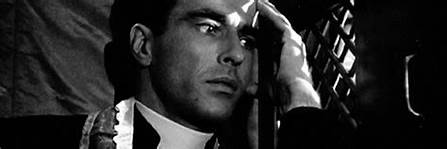
Sharing a classic with a young pastor.
Once of Alfred Hitchcock’s greatest pictures, I Confess concerns a priest who hears the confession of a man who has committed murder. Later, the priest learns to his horror the same man is implicating him for it. Taking advantage of the confessional seal he has set the priest up. Since the Catholic Church forbids breaking the confessional seal for any reason whatsoever, Robert Montgomery’s priest finds himself in a perilous situation. Even if convicted and sentenced to be hanged, he cannot divulge what he heard in the box. The picture concludes with a particularly moving scene where the killer, mortally wounded, asks the priest he wronged for his forgiveness and receives it.
Beautifully and dramatically shot by Robert Burks on location in Quebec City in the early ’50s, much of it in the grand and historic Hotel Frontenac (where this writer once spent a few comfortable days), I Confess is not only a thriller of the first rank, but also a treat for the eyes, as well the ears with its superb score by veteran composer Dimitri Tiomkin.
Your Tatler, having seen the picture before, watched it again a few evenings ago with his present pastor, who had not seen it. Not only did that priest enjoy it thoroughly, during the screening he made some enlightening observations concerning what Robert Montgomery’s priest character was or was not permitted to do while in his dire predicament.
***
Watching I Confess again summoned up memory of a sermon your Tatler heard many years ago at his parish church in New York. The pastor told of being fresh out of seminary in the ’70s and being assigned to a parish in the roughest part of the South Bronx. In those days that part of the City was in a state of collapse (rather like what’s happening now in the City), beset with horrendous crimes along with rampant and unchecked gang warfare.
Our pastor told of hearing one of his first ever confessions, that of a gang member who confessed he had just committed two murders. He then asked the perhaps shaken young priest for absolution and penance, which, after making his Act of Contrition, he received. The gang member never returned to the church and our pastor never learned his eventual fate, good or bad. Decades later, he pointed out to his enthralled listeners in the pews that gang member would not go to hell for the two murders confessed to. He might go to hell for other crimes not confessed, but not those two murders.
Hearing that sermon not long after being received into the Holy Catholic Church was forceful manifestation to this writer of the gift of God which is the sacrament of Holy Confession.
 The Taos Tatler